
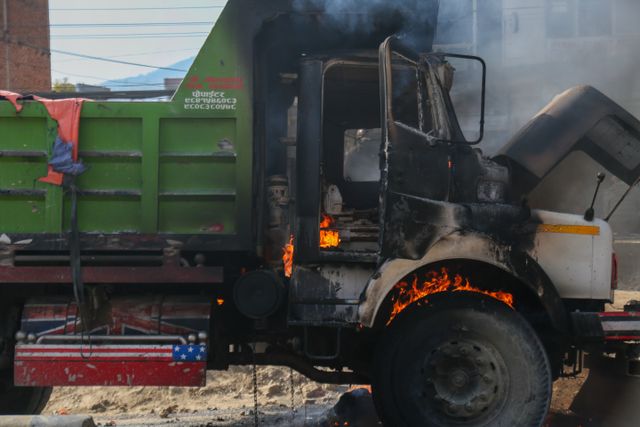
The insurance adjuster for the trucking company called before I’d even left the hospital parking lot. Two days after the wreck. They move that fast for a reason, and it isn’t your reason.
Here’s the thing most people get wrong about truck crashes. When two cars collide, you’re usually looking at one or two drivers and that’s the whole story. A tractor-trailer wreck is a different animal. One collision can drag in four, five, six separate companies, each one carrying its own insurance policy and its own lawyers whose entire job is to make sure the blame lands on somebody else. Ideally you.
The Truck Driver Is Rarely the Only One at Fault
So the driver. Start there, sure. Speeding, tailgating, fatigued, staring at a phone. All of that matters. But the driver almost never acts alone, and the law knows it.
Somebody scheduled that route. Somebody set the deadline that couldn’t be met without skipping a rest break. Somebody decided the brakes could wait another month. Those are three different decisions made by three different people, and any one of them can create legal exposure when the truck ends up in your lane.
How Trucking Companies Share Liability
Most carriers are on the hook for what their drivers do. It’s a rule called vicarious liability, and it means that if the driver caused the crash while working the job, the company answers for it. This is good news for you, frankly. An individual driver might have almost nothing. The company carries real coverage. Federal rules require most interstate carriers hauling general freight to carry at least $750,000 in liability insurance, and plenty carry a million or more.
And the company can be sued for its own failures, separate from the driver’s. Put a guy with a known history of violations behind the wheel? That’s negligent hiring. Never train him properly, never supervise him, let the maintenance slide? Each one is its own claim. If a carrier was leaning on drivers to falsify logs or skip breaks, that’s a pattern, and a pattern builds a case against the business that has nothing to do with what happened in the ten seconds before impact.
When Cargo Loaders, Shippers, and Brokers Are Responsible
Now picture the trailer getting loaded.
Cargo that shifts or sits overloaded causes rollovers and jackknifes, and here’s what people miss: the driver usually didn’t load it. Warehouses did. Freight handlers did. Some third-party loading outfit did. Stack it uneven, blow past the weight limit, strap it down with gear that’s already frayed, and the company that touched it owns a piece of the fault.
Shippers and brokers too. A broker who keeps hiring the cheap, unsafe carrier to pad a margin. A shipper who hands a driver a delivery window that can’t physically be made inside the legal hours. That’s pressure, and pressure pushes drivers into bad choices. Regulators said so out loud. The FMCSA rules make it flat illegal for carriers, shippers, receivers, or brokers to coerce a driver into breaking safety limits like the hours-of-service caps. When somebody ignores that and a crash follows, their conduct is now part of your claim.
Faulty Maintenance and Defective Truck Parts
Maintenance is the quiet one. These trucks run hundreds of thousands of miles and they fall apart without constant work. Brakes, tires, steering, the coupling that holds the trailer on. A lot of carriers farm the repair work out to outside shops. If a shop signed off on brakes that were already shot, or billed for an inspection it never really did, that shop is a defendant.
Parts makers, same idea. A tire that comes apart at seventy. A brake system designed wrong from the factory. A defective hitch. The crash happens even when every single human did their job right. Those cases run on different rules than ordinary negligence, and you’ll usually need an engineer or a reconstruction expert to prove them. The trade-off is worth it, because a manufacturer has deep pockets and a strong reason to settle when the defect is obvious.
Dangerous Roads and Government Liability
Sometimes it’s the road. Bad interchange design, a missing guardrail, lane markings worn down to nothing, a pothole that forces a swerve at the worst possible second. When the government agency responsible for that road let it rot, it can share the blame. Fair warning though, these claims come with brutally short deadlines and special notice requirements, often way shorter than the normal injury window. Sit on one of these and it’s gone.
North Carolina’s Contributory Negligence Rule Raises the Stakes
You need to understand contributory negligence before you do anything else, because it’s the whole ballgame here.
In North Carolina, if you’re found even one percent at fault for the crash, you can walk away with nothing. Zero. Only a few states still run this way, and it makes truck cases in this state unusually high stakes. The insurance company knows the rule cold, and it will spend real effort trying to hang a sliver of blame on you.
Which is the exact reason spreading responsibility across a bunch of defendants works in your favor. When five parties are all pointing fingers at each other, none of them has much energy left to point at you. A clean record showing the driver, the carrier, the loader, or the repair shop caused this wreck is what keeps you from getting painted as the careless one. You’ve got three years from the crash date to file a personal injury suit in North Carolina. But evidence vanishes long, long before that clock runs out, so three years is a trap if you treat it like a deadline instead of an outside limit.
Why Identifying Every Party Takes Fast Legal Work
None of this investigation is something you can run from a hospital bed. Somebody has to preserve the truck’s electronic control module data before it’s overwritten. Pull the driver logs and the dispatch records. Get into the maintenance files. Inspect the truck itself before the carrier quietly repairs or scraps it. Remember that adjuster who called me in two days? The company already had investigators at the scene within hours of the crash. You need someone doing that same work for your side, moving just as fast.
A lawyer who actually handles these cases fires off spoliation letters to freeze the evidence, subpoenas records from every company in the chain, and brings in experts to assign fault where it belongs. Firms like CR Legal Team do that legwork so every party that hurt you gets named before the trail goes cold.
Vet whoever you’re thinking about hiring. Look at the actual record, the client ratings, the standing. You can pull a firm’s background through its profile on Super Lawyers, and then ask them straight out how many multi-defendant truck cases they’ve actually worked. If they get vague, that tells you something.
What to Do After a Truck Accident
Get medical care and hold onto every scrap of paper. Photograph the vehicles, the road, the cargo and debris if you can stand up and do it. Write down the trucking company name, the USDOT number painted on the cab, the officers who showed up. Do not give the trucking company’s insurer a recorded statement before you know your rights. Do not take the early check.
That early check is the tell, by the way. It shows up before anyone knows how many companies are involved or how bad your injuries are going to get. That’s not generosity. It’s math, and the math is against you.
Most truck accident attorneys take these on contingency, somewhere between 33 and 40 percent of the recovery, meaning nothing out of your pocket upfront and nothing at all unless they win. That’s what lets an ordinary person go after a wall of well-funded corporate defendants without personally bankrolling the fight.
One thing stays true in nearly every serious truck wreck. The fault doesn’t stop at the driver. Trace every decision that stacked up behind that collision, and your claim gets stronger with each one, and a lot harder for any single insurer to shrug off and leave.